In today's world, widespread interactive behaviors (cooperation, competition, confrontation, etc.) have become the foundation for the stable operation of various systems. Game Intelligence, which has emerged accordingly, forms a decision-making knowledge base through decision modeling, solving, and optimization, serving as an important foundational theory supporting the national artificial intelligence strategy and major aerospace engineering projects. However, existing research struggles to effectively reveal the internal mechanisms and evolutionary laws of cooperative emergence in complex scenarios involving multiple agents and diverse interactions. Addressing this challenge, a research team led by Professor Wang Zhen from the School of Cyberspace Security at Northwestern Polytechnical University has developed a large-scale behavioral game model based on social networks and multi-strategy decision-making. For the first time, they revealed that social network agency (i.e., increasing the decision-making freedom of game intelligence within the network) can significantly stimulate group cooperation, trust, and fairness behaviors, providing a more solid scientific basis for improving collective intelligence management. The latest research findings were published in *Nature Human Behaviour* under the title "Social networking agency and prosociality are inextricable in economic games".
In this study, intelligent agents on the social network can adopt differentiated game strategies towards different interaction opponents, overcoming the limitations of traditional game methods in accurately depicting group multi-strategy decisions and enhancing the agency of network games. Results from different types of games consistently show that the flexible decision-making of intelligent agents can significantly stimulate pro-social behaviors within the network group. Through cluster analysis of the behavioral characteristics of differentiated groups, a unified interpretation and accurate prediction of game behavior patterns in multi-interaction scenarios were achieved (see figure).
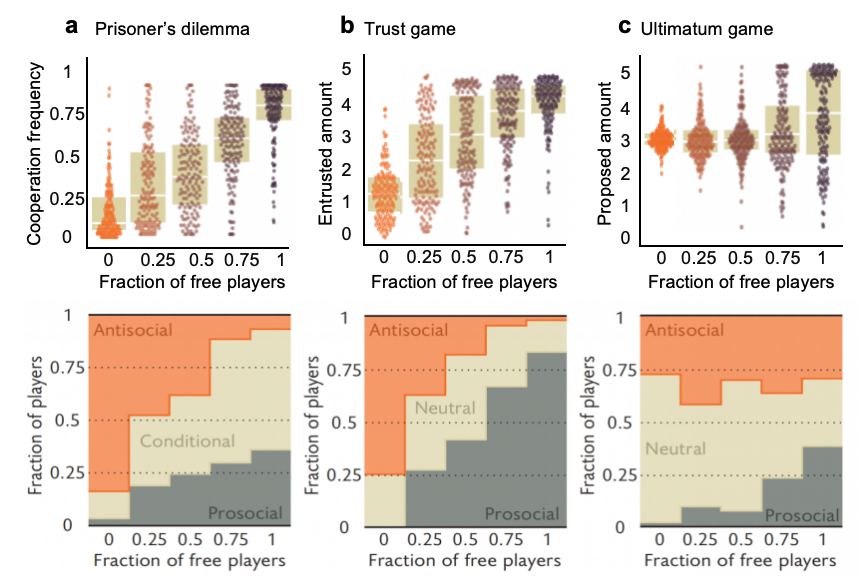
This research holds significant scientific importance for realizing collective intelligence and also provides new theoretical methods for the design of next-generation intelligent systems, thereby enhancing system effectiveness. For example, in complex battlefield environments, designing autonomous coordination mechanisms for unmanned systems that enable rapid strategy switching based on environmental characteristics is expected to enhance the robustness, survivability, and overall effectiveness of formation coordination and resource sharing in distributed unmanned systems.

